Showing posts with label Free Sewing Pattern. Show all posts

Saturday, September 19, 2020

Little Blanket Edge Felt Heart


 Morning all!

Today I have another little felt heart project for you. This one is just adorable, being that the finished hearts are only 1.5 inches.

For these hearts you'll need to download the template which is available for download HERE

Follow along with these super easy steps to make your own! I've found this heart looks best when you use a high contrast colour for the thread. 

You could also embroider small flowers into the front piece of felt prior to sewing.


You Will Need:

The template from the link above, cut out the 1.5 inch heart

A sewing needle

Some thread

A small amount of stuffing

A small amount of felt


1: Cut out 4 1.5 inch hearts from the felt.


2: Place 2 hearts together and blanket stitch around the outside edge, when you have a small opening left, be sure to push some stuffing inside (a pencil helps here) before you finish sewing.


That's it! It really only has the 2 steps! I told you it was easy. The beauty about these little hearts is they are so easy to customise with colour choice or adding on embellishments like tiny flowers or bows. How creative can you make them? 

This pattern is also a great one to introduce children to hand sewing, as the hearts are small enough that they wont need a super long thread to get tangled and can be finished fast, giving them some quick gratification for a job done. 


Sunday, September 13, 2020

Flat Sheared Heart


Good morning all!


Today's heart is another little sewn number, and it's even easier than the last one!

These hearts are super easy, require no turning and use minimal fabric. Perfect for using up the odds and ends in the sewing draws.

Follow the instructions below to make a pair. 


Flat Sheared Heart

For one pair, you will need:

The template, that you can download and print HERE

2 small rectangles of felt to use as the wadding

4 small rectangles of fabric for the outer pieces. These can be the same fabric for all 4, or you can have the front and back of the heart in different prints.

A pair of pinking shears to trim the edges and stop fraying. (Note, you can use regular scissors but you will need to use outer fabrics that do not fray)


1: Starting with the template, cut out the 3 inch heart.

2: Make a sandwich with your fabrics. Lay one printed piece face down, then the felt in the middle, and the front fabric face up. Place the heart on top and put a pin through all 4 layers to hold it in place. 


3: With your sewing machine (or if you prefer to hand stitch) sew around the outer edge of the heart, being careful not to catch the paper template with the sewing needle. 


4: When you have gone around the entire heart take the pin out, remove the template and cut around the outer edge of the stitch line with the pinking shears.


5: Make a second heart in the same way so you have a matching pair! 

That's it lovelies, like I said, this one is very simple, and a great little project for anyone new to using a sewing machine.

You could easily make this with the 2.5 or 2 inch heart templates also if you have a smaller piece of fabric to use. 


Thursday, September 3, 2020

Double Love Felt Heart


Good morning all!

Today I have something a little different to share with you all for the IBGHD. This is for all of you who wanted to join in but don't know how to knit or crochet. 

This little felt heart is fast to make, simple, and uses no fancy stitches, yay!  I have a couple of sewing patterns to release this month so keep an eye out for them.

You Will Need:

Felt in 2 colours

A sewing needle

Thread, cotton or thin yarn to sew with

The pattern

The pattern/template for the Double Love Heart can be found here you will need the 2.5 inch and 1 inch hearts. 


Step 1: Print out the pattern. Be sure that the 1 inch test box is 1 inch. There are multiple sizes on the one sheet (because we have more patterns later in the month) but for this one, you will need the 2.5 and 1 inch heart templates.


Step 2: Cut out 4 of the 2.5 inch hearts and 2 of the 1 inch hearts


Step 3: Sew the small hearts onto the front of a large heart. Make sure both front pieces are positioned the same. 


Step 4: Sew the front and back pieces of the heart together, when you have one side left stuff lightly before continuing to the end.


You could easily change this one up by using a blanket stitch or a more contrasting thread.


Friday, July 24, 2020

Pandemic Paraphernalia - A free mask pattern.


Hello all!

Today I have something a little different to share with you all. As you're all very much aware, the globe is currently dealing with a pandemic. In many places it's now become mandatory to wear a mask in public, to help slow the spread of this virus.

This pattern comes from The Crochet Case and is an adaptation of a pattern from Mister Domestic

Laura from The Crochet Case has asked me to share the pattern here via the blog so it is easily accessible by whomever needs to make one.

Of course, I had to have a go too!

I'm pleased to say that this is a quick and easy sew. The supplies are simple, and my second one took less than an hour from start to finish. The multiple sizes are great! My partner and I fit into the large well, and my 3 teenagers all wear a medium. I am yet to make a child size but that's on the weekend to-do list. As a side-note, how adorable is my chicken fabric??

If you have a bunch to make, do them in steps. Cut them all out, iron them all, add all the elastics etc, it'll go much faster than making one at a time from start to finish.

So, what do you need?

Fabric! I used cotton fat quarters from my stash, Laura has upcycled vintage linen placemats. washable and breathable is your goal.

Hat elastic (or thin flat elastic) 6.5-8 inches per ear

Some fusible woven interfacing in either medium or light weights.

That's it!

Here are some notes and tips to help you along. 

* If you are using hat elastic like I am, you'll need to make sure you add a knot to the end that's being sewn in to make sure it doesn't slide out.

*If you can't find elastic, or prefer to have ties, 4x 40cm long ribbons do the trick. 

*If like me you have a few extra chins, and feel like you need the space, add an extra half a centimetre to the bottom of the pattern only.

*The recommended elastic length is 6.5 inches, I used 8 and then tied off any extra, because again, I have a chunkier face. It would be very easy to adapt to full elastic backs rather than ear loops also.

*In the tutorial video it shows the interfacing being already ironed onto the outer fabric prior to cutting it out, I prefer to cut the interfacing from the pattern piece and then iron it onto an already cut outer fabric piece to save on interfacing wastage. 

*I have used both medium and light weight interfacing and found they both work well. 

*Be sure to test the 1 inch test block when you initially print the pattern to make sure your sizes are correct. For most people printing at "Actual size" is enough to get you there, for others you may have to adjust. I needed to use 110% scale for one of my printers to reach the correct test size.

*You can get a full mask (outer and inner fabrics) from one fat quarter, yay! 


Wednesday, April 22, 2015

Seahorse and Giraffe Baby Toys from Upcycled Fabric - Free Sewing Pattern


Good morning all!

For the last few weeks Ive been working away at the craft challenge over at Angels for the Forgotten One of the items requested is for baby toys and taggies. The goal. 200.
I looked at the mountain of reclaimed fabric sitting in my hall and knew I needed to put it to good use, and what better way then for some baby toys. The fabric was already wonderful and soft and there were some fun colours so why not! My reclaimed fabric comes from all sorts of places, mostly Tshirts and Shirts from thrift stores or given to me by friends and family. I reuse whatever I can.

I decided to start with some basic animal shapes, because they are fun, simple and easy for a bub to hold. Ive seen a few similar ones, but the printer wasn't working so I figured I'd just draft my own. I shared the photos in the craft group and it was asked if I'd mind sharing the pattern. So, here we are!

To date I have the following animals: Seahorse, Giraffe, Fish, Whale, Crocodile and Duck but I have plans for more. The pattern will fit on an a4 sheet of paper, and the shapes are simple enough that anyone can have a go, great for beginners practising curves! You can use any ribbon or lace that you like. Mine is a little boring, because I only have a handful of colours but you could really go wild. I'll pop 2 up at a time. I monkeyed with the shape a little for the giraffe until I was happy with it.  It took a bit to find the right amount of neck and leg but I got there.


Here is a quick overview of how to make them. I didn't take a lot of photo's because I completely forgot but these are so easy you won't need to see it all.

1. Take your pattern and lay it out on your fabric. Pin it down and cut around. You will need to pieces. I find it easier to cut both sides at once (pin to a doubled over piece of fabric) This is super easy if you are using say a t-shirt, it's already doubled!

2. Lay one piece right side up. Cut strands of ribbon. Mine are anywhere from 4-7cm long. Fold in half and pin into place on the fabric. They need to be facing inwards, with the fold towards the middle, so when you turn it all in the right way it will be on the right side.

LARGE FIN FOR SEAHORSE:
You have 2 options here. You can use a wider ribbon for the fin, or you can use the template provided to sew one. Cut out 2 pieces, pin with right sides together and sew up one side, across the curved end and back down the other side. Leave the end that gets sewn into the seahorse open so you can turn the fin in the right way. Pin it the same way you would pin the ribbon, facing inwards.


3. Lay the second piece of fabric on the top, right side down. Pin the edges.

4. Sew around the fabric, leaving a 2 inch gap for stuffing.

5. Trim any excess fabric and clip corners/curves and turn in the right way.

6. Stuff the toy! Not too much stuffing, you want it to hold its shape but not stretch the fabric.

7. Sew the stuffing hole closed with a ladder stitch. This will be almost invisible.

TADAA! You made a baby toy!

Sunday, April 6, 2014

Burial Gown Free Sewing Pattern for Preemies - Harper Gown


Good afternoon all.

Today I have something a little different for you all. Lately Ive been browsing burial gowns trying to find a pattern that was simple and easy and free. One that opened at the back, didn't involve an overlocker and didn't have these tiny little arm holes which I am sure would be a pain to actually use.

So, I sat down and drafted my own up.

Like Ive said in previous sewing tutorials, I am in no way, shape or form amazing at sewing. I am self taught and my method is to throw some stuff around and hope for the best.

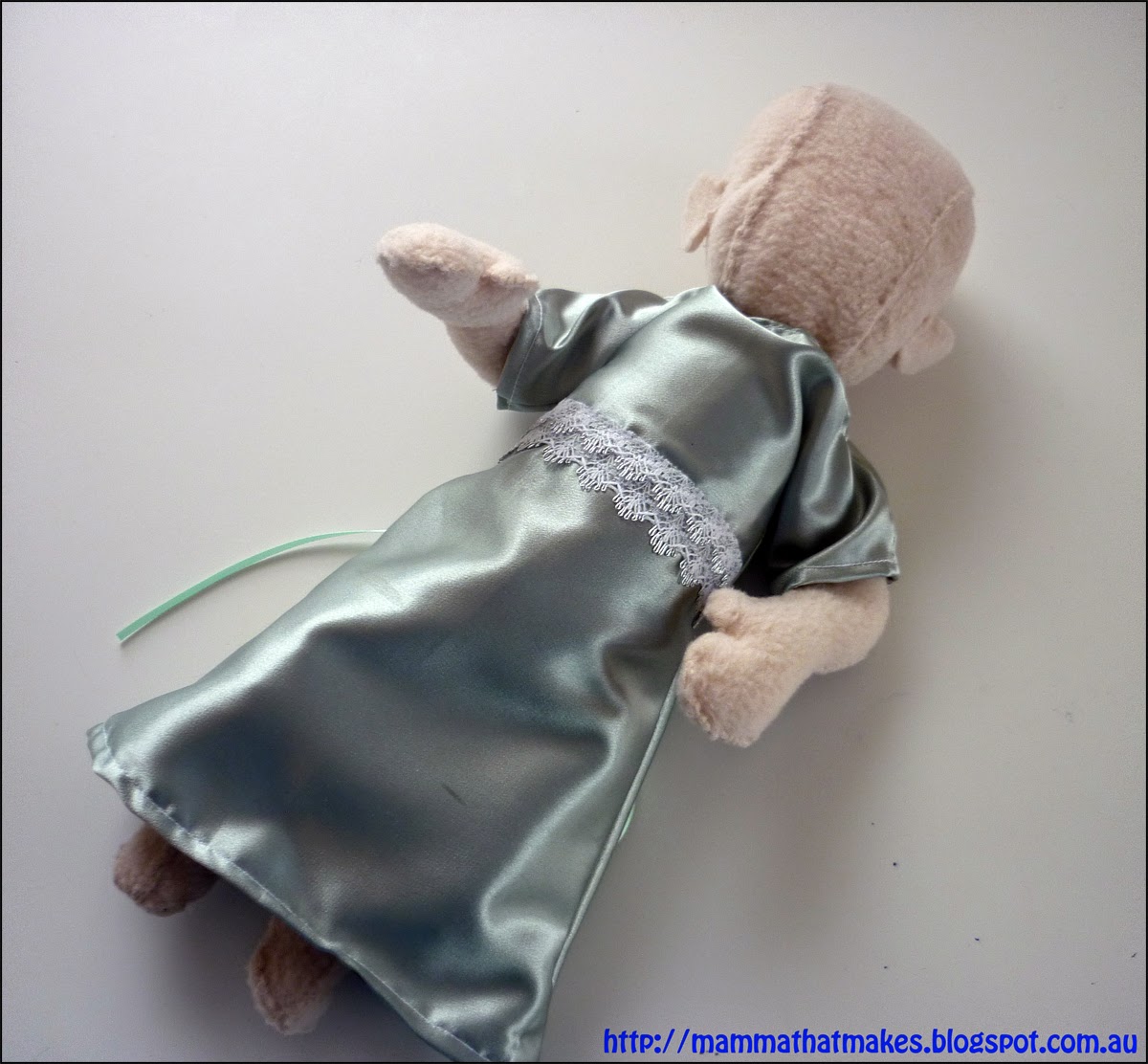
So, this pattern may not be outstanding, and it may not be as amazing as some I have seen recently, but it IS simple, easy, fast and lets face it, if I can put it together, anyone can! and most importantly its free! It is also very easy to customise. It features an open back, and has wide sleeves which will make putting on baby so much easier.
The doll I have it on is 24 weeks gestation, so Id say it will fit around 22-26 weeks give or take. Again, very simple to make it larger.

I also want to apologise in advance for the photos. Every time Ive had a spare minute to work on this has been either a rainy day or late at night. So excuse the cruddy images :)

You will need:
Some fabric. I have used cotttons, flannels and satins so far all with success.
Decorative ribbon/lace trim (about 15cm long)
Thin Satin Ribbon for back ties (15cm each)
Scissors, thread, pins and of course a sewing machine.

Grab the pattern here:


Cut out the 3 pieces of material you will need to make the gown, one on the fold for the front and 2 pieces (not on the fold) for the back, using the lines marked on the pattern. (back piece is slightly wider to allow for hems)


Pin the decorative ribbon or lace trim to the front of the gown and stitch it on. As you can see, I folded my piece in half first, as I thought it looked better then the single strand.


Next, with right sides facing, sew the back and front pieces together at the shoulder seams.


Hem the edge of the sleeves.


Hem the back opening.


And then do the neck opening


With the right sides together, pin the ribbon ties in place, with the majority of the ribbon facing inwards, then just sew up the sides of the gown.


The last step is to hem the bottom of the gown and that's it, your done! Told you it was simple.
I'll be adding photos of the ones I make on my FaceBook Page so if you want to see what materials/colours/trims ect I use by all means pop on over and have a look.

I hope this helps everyone that was looking for a free and easy sewing pattern. If you have any questions I'll try my best to answer them, but like I said before, Im not terribly great at sewing and if you have a better way of doing this by all means.

Also, if I had a pair of pinking shears Id have used them for all the edges to stop any fraying. Unfortunately I don't own a pair, nor do I have an overlocker (serger) but if you do, then I'd go with them to make the job a little neater and easier.


Thursday, February 20, 2014

Basic Arm Splint Tutorial + Free Pattern


Hello everyone!

So today I have something a little different for you. Its a sewing pattern/tutorial. GASP! You say, where fore is the crochet? Well if I could have crocheted these little beauties I probably would have alas, sewn works so much better!


The whats and whys and hows? Well, one of my closest friends has a grandson who was born with Bilateral Cleft Lip and Palate. This requires Master R to have a few various surgeries to repair both his lip and palate. After his operations, it was important that he not touch his face in case he hurt the area, dislodged stitches or spread germs and caused an infection. The easiest way to stop a child from touching their face, is to immobilise their arms.


Well, it turns out there wasn't a lot of options for purchasing them and the few available were pretty costly, so Master R's nan asked if it was possible to make some. That's right, I made some :D The first few were pretty scary looking, and much more complicated then need be so I kept working on them and am now happy with the final pattern.

Call me crazy, but something like this should already be a part of going in and getting the op's done, having to source and pay for a pair of childs arm splints on top of an already incredibly stressful (and expensive once you factor in travel distance, special bottles, accommodation ect!!) time just isn't right.
We've since been working on making sets to donate to the Royal Hobart Hospital, and hope to distribute more to any family that needs them.

Before I go too much further, Id like to link up a support group called CleftPALS Victoria (Aussie based group) there are many more out there, but this is the one my friend is in and so the one Id like to share :) If you'r in Tassie of Vic and have a cleft bub head on over :)

Now the size I have here will work from about 5-6 months up. I tried a pair on Miss M (below) who is now 8yrs and they not only fit, but she was unable to scratch her nose, Id call that a success. To make them smaller, just shrink the overall size a few cm's. They are not hard to do, just fiddly, especially sewing on all the velcro
tabs.


Let this be a prewarning, do NOT use sticky backed velcro! It clogs up your machine's needle. I totally learnt that the hard way!

Id also like to add that as far as sewing goes, I am totally self taught with the hit n miss method! If there is a neater/simpler/better way of doing this then by all means. This is just how I did it, in my have a crack way :)

Supplies: to make one PAIR (2 splints)

Inner material - Use something thick like fleece. It doesn't matter what colour this piece is, noone will see it. Cut 2 pieces of 25.5cm x 30cm
Outer Material - This is the part you will see. Pick bright fun fabrics, they appeal more to the little ones. I use flannelette and/or cotton. I prefer to use flannelette for the back piece, as this is the side touching a childs skin, its nice to make sure its soft and won't irritate.  Cut 4 pieces of 25.5cm x 19cm
Velcro Tabs - Fabric choice is less important here, just make sure its nothing too thin or the Velcro might tear it, even once sewn down. I go with cottons and flannelettes. Cut 4 pieces of 8cm x 25cm
Velcro - Cut 8 pieces (4 of each surface) at 10cm long.


Hard pieces for the inserts: The easiest thing to use for this is tongue depressors. They are super sturdy, can take a beating and are the perfect size. If you have none (and you will see in this tutorial we had none handy at the time) you can use a few other things. We have had great success with cutting the same shape/size from ice cream containers. A depressor is 2cm wide and 15cm long. If you cut your own from anything else remember you must curve the ends so they are not sharp!! Ice cream container pieces by themselves are good for small babies, but once they get mobile, double up on them! (place 2 in each slot)
I have also made a pair by taking 2 plastic knifes (99cent bbq cutlery) turning one upside down (top and tailing them) and sticky taping them together. The size is only slightly smaller then a depressor would be. Ive just been told that jumbo craft sticks are also 15x2cm. Whichever is the best option for you, just roll with it. Just make sure your chosen material is washable, as the idea of these is to be reusable.
You will need 6 depressors (or 12 ice cream container cut-outs) to make one set of splints.


 Sewing machine/cotton/pins and some patience too.

Starting with the inner piece.
Fold your 25.5x30cm piece in half. Lay 3 depressors on top and space them evenly. Use a pen or marker to draw down each side on the material to mark where the edges of the depressors are. My marks are a little hard to see so Ive added some pins to help show you.
Sew down each line from one side to the other. This creates little pockets for the depressors to sit in.
Push the depressors into their pockets (2 per if your using ice cream containers) and then sew across the top to encase them in. Make the second one the same way. Put these aside.


Velcro Tabs.
Take your 8x25cm piece of fabric for the tabs and fold in half, slightly creasing the centre fold. Unfold the piece again. Position the velcro on one side of the tab, about 1cm back from the centre crease. Sew the velcro on. I go around the outside of the velcro piece twice to make sure it stays put.
Fold the piece in half, right sides facing and sew down the long sides, leaving the end open for turning. Turn piece in the right way. Repeat for the last 3 tabs.


Velcro on the outer. 
Take one of the outer pieces of material. Position your velcro 3cm in, and 4cm up
(or down for the top piece) as shown. Sew around the velcro pieces to secure them in place. Repeat with a second outer piece.


Now its time to make a splint sandwich. This is a little complicated so lets take it step by step.

Take one of the outer pieces that has NO velcro on it and lay it right side UP.
Place your velcro tabs on the right hand side facing IN and with the velcro tab facing DOWN (use the outer with the velcro tabs to get a good position for them shown below)


Place the outer layer WITH the velcro on top, right side facing DOWN and the velcro tabs on the LEFT


Now place the inner layer with the sticks on the very top. You will see that its the same size in length but not in height. This is so it can be turned. It is very important when sewing the sandwich together that you do not catch the edge of the inner piece OR the velcro tabs in the needle.


Now starting on the top of the piece sew around, leaving at least a 15cm gap unsewn at the top. I usually reverse over the velcro tab section a few times just to make sure its all nice and secure.

Once you are done turn your splint in the right way. This can be a little tricky, especially if your inserts are depressors as they have very little bend. Once in the right way make sure to poke all the corners out. Now pin your gap closed and simply sew around the entire edge, this closes the gap and keeps everything nice and neat as well as reinforces the inner pieces and tabs into place.

Thats it, splints done! The hardest part of these is adding the velcro. Maybe its just me but it takes me a good 30 minutes just to attach all the little buggers! Still, the end result is totally worth it. Maybe you'd like to make some for your local hospital? Just give them a call and see if they need them. Ronald McDonald houses may also be happy to accept a stockpile for the families that stay there. Just please don't make money from this pattern. I know I can't police that, but its just not right to use someone's hardship like this to make a buck. 

And if you'd like to share pics of your little ones sporting a pair of these, by all means go for it, I'd love to see :D


Tuesday, May 22, 2012

Crayon Roll Tutorial


Hey howdy hey! I think this is my first sewing tutorial. YAY for me!

Now the crayon roll is not a new idea, I've seen them before. I wanted to do my own and so here it is. I started making these because I'm using up leftover material and sending them to Angelsfortheforgotten which will go into their bags for kids going into crisis or foster care. Yes once again its another charity pattern. What can I say, I just enjoy helping!

This really is easy to make, and if you were to set up a bit of a production line you could easily make a few in an hour. As always, do what you will with these patterns just don't copy the images and text and pretend it came from your brain, that's a no-no ok. I think these would do well at school fetes and boot sales as well as fundraising!

For this tutorial you will need:
Some material. I have some cotton blends.
50cm of ribbon
a measuring tape or ruler
some cardboard or paper if you want a pattern.
pins
cotton
a marker
crayons
and a sewing machine.


First some measurements. I'm using Ben10 crayons that are thick and chunky and excellent for smaller hands. They need pockets that are 3cm wide to fit in snugly.

My template is a simple square that measures 22cm x 17cm This includes seam allowance.
On my template, you can see I've marked off the spaces for the crayons. I put a mark at 11cm, then counted on each side 3cm gaps.


The material! You need to cut 3 pieces of material out for one roll. I use 2 colours, however you can use multiple. I have one for the pocket and one for the back and front. Cut out your three pieces!


Fold your front pocket piece in half, and pin it to the backing piece. Right sides up and so the fold is at the top!


Using a fabric marker (if you have one, or you can be a slaphappy like me and just use one of the kids markers) put some small dots on the bottom of the pocket material so you know where your lines need to be sewn.


Now its simply a matter of feeding the material through your sewing machine to create straight lines, starting at the bottom and going right to the top of the backing piece of material. You should up with 7 stitched lines.


I know I know, I could have picked a better cotton, but its all I had. Trim the cotton dags off.

Cut a piece of ribbon to 50cm. Fold it in half. Stitch the fold end to the material as shown below.


I put mine on the right side, but really you can put it on either. Just make sure that the ties are facing inwards.

Now place the 3rd piece of material on top of the pocket piece, right sides facing. Make sure to tuck the ribbon in so you do not sew over the free ends. Pin it down and sew around the edges, making sure to leave a gap about 3 inches wide so you can turn it.


Reach in and grab the ribbon and pull it through the gap, this will help you turn the whole thing in the right way.


Now you have this annoying little gap to deal with. Most people would go ahead and hand sew that closed. Alas, like I've stated before, my hand sewing skills are horrid bad shocking disastrous! So starting in the bottom left hand corner, I top stitch very very close to the edge up the left side, across the top and down the right side. This gives it a nice edge and closes that pesky gap for me!

Give it a quick iron to make sure its all sitting flat and all you have left to do is fill it with crayons!

And to prove that even I make muff-ups and these things don't just work out amazingly, here is my first one. Which is a little short, and has top stitching all the way around. I guess we all learn from trial and error huh!